How much do the electronics in your product really cost?
7 Critical Factors You Must Know Before You Invest
Do you dream of your product “gaining intelligence” by offering customers features that your competitors don’t have yet – such as remote monitoring or task automation? Great! However, before we fully step into the digital revolution and begin designing innovative solutions, we must face one of the biggest question marks in business: the real cost of electronics manufacturing.
Many companies worry that this process is too complex and financially unpredictable. In this article, we will break down the 7 most important elements that influence the final price of your electronics. This will give you the essential knowledge needed to make informed decisions, avoid costly pitfalls and optimize your budget right from the start.

1. The Design Phase – The Invisible but Crucial Costs
Although components and factory assembly may seem the most expensive at first glance, the pivotal decisions that determine up to 80% of your product’s final cost are made much earlier: during the design stage.
This initial phase, often referred to as research and development (R&D), involves the intellectual work of engineers and conceptual testing. Investing in a solid, well-thought-out design is the most significant cost savings you can realize, as changing a component or circuit layout after mass production has begun is incredibly expensive. Within this phase, you must account for the labor costs of experienced specialists – hardware engineers designing the electronic circuits, software engineers writing the code, and housing and mechanical design specialists.
The more complex and unique features your device requires, the greater the design effort, the more prototype testing will be needed, and, consequently, the higher the upfront cost. Remember, prototyping and early testing are not expenses, but an insurance policy protecting against major defects in the final product.
2. Components – The Heart of the Cost Dilemma
Once the design is ready, we move on to quoting and purchasing the parts, which creates what is known as the bill of materials (BOM). This is the physical heart of your product, and its cost depends on several critical factors.
The most vital and costly components are typically the microcontrollers (MCUs), which serve as the “brain” of the device, memory chips, and communication modules that enable connectivity, such as internet (Wi-Fi) or phone (Bluetooth) links. The price of these parts is not fixed; it depends primarily on your order size (volume) – the more units you purchase, the lower the per-unit cost becomes. Furthermore, you must prioritize quality: using popular, readily available components from well-known brands (technically referred to as standardization) often proves cheaper and safer in the long run than hunting for the cheapest anonymous alternatives.
Keep in mind that saving 50 cents on a single component can vanish instantly when expensive failures and warranty claims arise due to low component reliability.
3. Production – From Board to Finished Product
Once components are selected, the physical manufacturing phase begins. This consists of two main stages: fabricating the printed circuit board (PCB) itself and its assembly (PCBA), which means placing all the electronic components onto the board.
Costs here depend on the complexity of your design. The more layers (conductive traces) the board has, the more densely packed the components are, and the more specialized the materials used for PCB fabrication (e.g., for devices operating in extreme temperatures), the higher the unit price will be.
Next, assembly can be performed in two ways: SMT (surface-mount technology), which involves automated placement of components onto the surface and is cheaper at high volumes, and THT (through-hole technology), where components are inserted through holes – the latter often requiring more manual labor.
The location of the factory is also a key decision, as labor and logistics costs vary significantly by country. When choosing a manufacturing partner, remember that the lowest price for assembly alone does not always mean the lowest total cost – cheap labor often comes with a higher risk of quality and logistical issues that will ultimately eat up your savings.
4. Testing and quality control (QC) – an investment in reliability
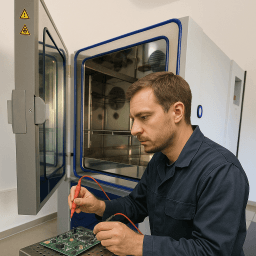
In an effort to minimize costs, many entrepreneurs are tempted to cut spending on testing and quality control (QC). However, in the long run, this can prove to be the most expensive mistake. This phase focuses on verifying that the manufactured electronics perform exactly as designed. It requires developing specialized hardware and software, known as test fixtures or jigs, which automate the inspection process for every single board.
Various types of testing are utilized – ranging from electrical tests (verifying that all connections are correct), to AOI (Automated Optical Inspection – checking for assembly accuracy), and functional tests (ensuring the device performs its tasks, such as connecting to Wi-Fi). The more rigorous the testing regimen, the more defective units are caught at the factory level before they ever reach the customer.
Remember that the cost of repairing or replacing a defective product that has already reached the end-user, coupled with the potential reputational damage, is many times higher than the cost of robust quality control at the factory. Therefore, testing is not an expense to be trimmed but an indispensable investment in durability, reputation and customer satisfaction.
5. Certifications and Regulatory Compliance – Your Passport to the Market
Before reaching the consumer, electronics must comply with a variety of legal and technical requirements. This is a cost that cannot be bypassed, as it is literally your passport to the market.
This phase involves securing key certifications such as the CE mark (mandatory in Europe), FCC (in the United States), or RoHS (restricting the use of hazardous substances in equipment). Obtaining these certifications requires expensive laboratory testing and audits to verify that your device is safe and does not cause interference with other equipment. If you operate in a specialized sector, such as the medical or automotive industries, costs escalate because additional, more stringent, and time-consuming industry-specific certifications are mandatory.
The most critical piece of advice: certification planning must occur as early as the design stage; attempting to retrofit a finished product to regulatory standards at the last minute almost always results in expensive design re-engineering and delays product launch.
6. Tooling and Jigs – Upfront Implementation Costs
Tooling and jig costs are one-off upfront expenses incurred at the beginning, but they are absolutely essential to initiate mass production. While these can involve substantial sums, they depreciate quickly over higher production volumes.
The two primary components of this cost are:
Injection molds (tooling): If your product requires a custom plastic or metal enclosure, specialized injection molds must be fabricated. These are high-precision steel dies that give the enclosure its final shape. The initial cost of the mold is high, but once created, it enables the production of tens or even hundreds of thousands of identical enclosures.
Test fixtures (jigs): As mentioned in the QC section, dedicated stations and fixtures are required to accurately test each manufactured board. This equipment must be custom-designed and built specifically for your product.
While these fees may seem steep at launch, they are critical for repeatability and quality. Most importantly, these are fixed costs that, at scale, are amortized across many units, significantly driving down the final per-unit price of your device.
7. Production Volume and Logistics – The Power of Scale
The final, yet highly significant element influencing the unit cost of your electronics is the scale of production and how the product reaches the customer.
This is where the economies of scale fully manifest. If you order 100 units of your device, the per-unit price will be drastically higher than if you ordered 10,000 units. This occurs because all one-time upfront costs (R&D, injection molds, test fixtures) and the manufacturer’s fixed overhead (production line setup) are distributed across a larger volume of products.
Furthermore, logistics cannot be overlooked. Shipping costs, warehousing, and the product packaging itself must be factored into the final price. Packaging optimization (e.g., designing a smaller, lighter box) may seem like a minor detail, but across thousands of shipments, it yields major savings on freight costs. Therefore, when determining your minimum order quantity (MOQ), keep in mind that higher volume equals lower unit cost, which directly translates to healthier profit margins for your company.

Summary: Take Control of Your Costs
Understanding electronics manufacturing costs requires looking far beyond the price tag of an individual component. As we have seen, the decisions made during the design phase (R&D) – where complexity is determined and components are selected – have the greatest impact on the final unit price. These costs are subsequently shaped by necessary expenses for certification (your license to trade) and tooling (which guarantees repeatability), and are ultimately optimized by the scale of production.
Introducing electronics into your product is not merely an expense, but above all a strategic investment in innovation, automation and competitive advantage. Armed with knowledge of these 7 critical factors, you gain full control over your budget and can confidently negotiate terms with your manufacturing partners.
What’s next?
You don’t have to do it alone! If you are just starting to think about upgrading your products with electronics and need a reliable estimate that factors in all of these variables, contact our expert team today. We will help you develop an optimized plan and budget before the very first prototype is even built.