You have a great idea for an innovative product, but are you worried about the cost of implementation? Do you think it’s enough to just add up the price of the processor and a few components?
Reality is more complex, and we will show you how to approach budgeting in a way that ensures peace of mind and predictability. Understanding the entire cost structure – from the initial concept to the finished product – is the key to success. However, before we start discussing the budget, we must talk about business analysis, as it forms the foundation of every successful investment.
Why is business analysis crucial before project discussions?
Business analysis is the foundation of every project because it allows for a precise definition of its goals and ensures that the investment will deliver real value to the company. Without it, even the best technical solutions may prove to be unsuccessful.
Why is business analysis crucial?
Defining project goals: Business analysis answers key questions: Who is the customer? What problems should the product solve? What is the project’s business objective? Understanding these issues allows for the creation of a solution that actually meets market needs.
Risk minimization: Without analysis, you are talking to a technology partner “blindly,” risking that the finished product will not meet expectations and that time and money will be wasted.
Cost optimization: An engineer who understands the business goals can propose a realistic and optimal solution. This ensures that your project investment is focused on what truly delivers value, rather than on unnecessary features or technologies.
Investing in business analysis is the simplest way to ensure that all the work and capital are allocated toward something that will actually bring the company value and a competitive advantage.
Cost Analysis – What Should Be Included in the Budget?
There is no single, fixed answer to the question “what is the cost of an electronics project,” as it depends on many variables. It is a bit like asking how much a car costs – it all depends on the brand, model, features, and engine. Generally, the cost of an electronics project can be divided into several main categories:
Research and development (R&D) Costs: This includes the compensation and labor hours of engineers who design the schematics, the printed circuit board (PCB), and the software. The more complex and innovative the project, the more time and resources it requires.
Material and prototyping costs: This covers the price of all electronic components (from resistors to processors), the cost of manufacturing the PCBs, and their assembly to create the first test units, known as prototypes.
Testing and certification costs: Many electronic products must meet strict standards and hold appropriate certificates (e.g., the CE mark in the European Union). The testing and certification process can be very expensive and is essential for the product to legally enter the market.
In simple terms, a very basic project including a prototype costs at least a dozen thousand PLN. For more complex solutions with dedicated components and advanced software, costs can reach several hundred thousand or even a million PLN.
The final cost depends on:
Project complexity: The more features and advanced technologies involved, the higher the cost.
Number of prototypes: Each subsequent version for testing represents an additional expense.
Production volume: Designing with mass production in mind might be more expensive during the R&D stage, but it ultimately lowers the unit cost.
Practical Examples and Case Studies
To better understand how all these factors influence price, let’s look at two example projects. Imagine that Company A wants to create a simple smart light switch, while Company B is developing an advanced industrial sensor that monitors several parameters simultaneously and sends data to the cloud.
Project A (simple light switch):
Low complexity: Few features, simple PCB layout.
Low-cost components: Standard, readily available parts.
No wireless certification: No requirements for Bluetooth or Wi-Fi.
Project B (advanced industrial sensor):
High complexity: Multi-functional, requiring data processing software.
Specialized components: High-precision sensors, long-range communication modules.
Mandatory certifications: The need to obtain wireless communication certifications, which significantly increases costs and extends testing time.
As you can see, the price difference results not only from the quantity of materials but, above all, from the project’s complexity, quality requirements, and the necessity of meeting standards. Sometimes a seemingly simple device that must meet high industrial standards can be more expensive than a multi-functional home gadget.
Electronics Design Based on an Existing Product
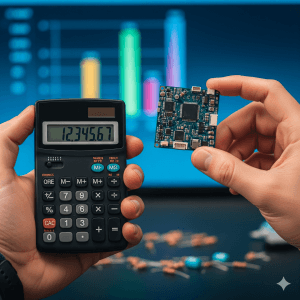
It occasionally happens that basing an electronics design on an existing product does not lower costs at all – on the contrary, it may actually increase them. This is often an illusory saving. Analyzing and replicating an existing solution (reverse engineering) requires not only time but also specialized expertise, which can be more expensive than designing a completely new solution from scratch. Furthermore, it may turn out that the components used in the original version are already obsolete, unavailable, or simply inefficient. This necessitates their replacement and generates additional costs at both the design and production stages.
Common Mistakes and Pitfalls: What to Avoid?
Even the best plan can encounter obstacles, and in electronics projects, there are several typical pitfalls that can ruin both your budget and schedule. Knowing where they lurk is essential to avoiding them.
Overly optimistic estimates: This is the first and most common pitful. Many companies assume that everything will go smoothly and that no technical issues will arise. Unfortunately, in innovative projects, errors are inevitable, and fixing them takes time and money. This is why experienced managers always include a contingency reserve in the budget for unforeseen expenses, typically 15-20% of the total amount.
Choosing components with poor availability: You might find that a selected processor is perfect, but its lead time is dozens of weeks. This, in turn, delays the entire project and may force costly changes during development. It is crucial to consider component market availability as early as the design stage.
Ignoring certifications (CE, FCC, UL): Managers often overlook these, yet testing can be very expensive. However, this is an expense that cannot be skipped if you plan to launch the product on the market. Omitting this step can lead to serious legal consequences and even a product recall.

Summary
Understanding the costs of an electronics project is not about guesswork; it is about strategic planning. As you can see, a budget is much more than just the price of components – it is an investment in expertise, prototyping, testing, and certifications that guarantee your product will be reliable and ready for market success. Approaching a project transparently and with full awareness of all costs allows you to avoid unpleasant surprises and builds a solid foundation for your business.
Check out our offer and see for yourself how transparent and efficient a project can be from start to finish.