From smart medical devices to advanced industrial automation systems – smaller components mean greater possibilities, higher efficiency, and entirely new functionalities.
In a world where every millimeter and every watt matters, designing electronics on a micro-scale is becoming a decisive factor for competitive advantage.
Modern industry faces dynamic changes driven by rising expectations regarding product performance, energy efficiency, and functionality. In this context, electronics miniaturization is no longer just a technological curiosity; it has become a fundamental pillar of innovation, opening doors to solutions that seemed impossible just a decade ago.
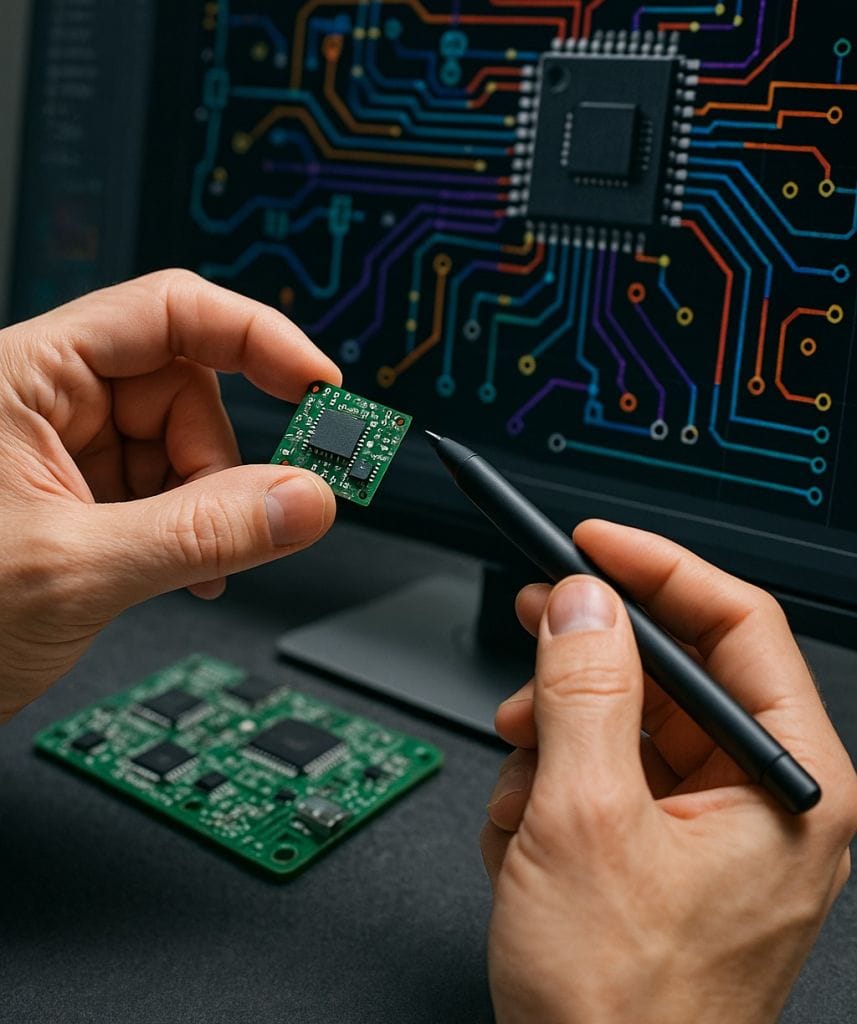
Evolution Toward “Less is More”
For years, the dominant trend was to increase computing power by scaling up component sizes. Today, we are witnessing a reversal of this tendency. Advances in semiconductor manufacturing techniques, the development of materials with novel properties, and innovative chip packaging and integration methods allow for packing more power into ever-smaller enclosures. This paradigm shift has immense implications for B2B companies striving to streamline their products or create entirely new ones.

Business Benefits of Miniaturization
Enhanced design freedom: Smaller components free designers from spatial constraints, enabling the creation of more compact, ergonomic, and aesthetic products. This is critical in industries such as medical (e.g., miniature endoscopes), automotive (e.g., advanced ADAS systems in limited spaces), and the Internet of Things (IoT).
Improved energy efficiency: Smaller circuits often feature lower power consumption. This is vital for battery-powered devices, where long battery life is a key selling point. In industrial applications, this translates to lower operating costs and a reduced carbon footprint.
New functional possibilities: Thanks to miniaturization, it is possible to integrate multiple previously separate functions into a single product. Examples include multi-functional sensors that collect data on various environmental parameters while occupying minimal space. This paves the way for creating more complex and intelligent systems.
The Future Belongs to Micro-Solutions
For companies aiming to remain leaders in their industries, understanding and leveraging the potential of electronics miniaturization is an absolute requirement. It is not just about adapting to current trends, but about actively shaping the future of one’s products. Investing in partners with expertise in designing and manufacturing advanced integrated circuits and small-scale modules is an investment in innovation, competitiveness, and long-term success.
Is your company ready to leverage the potential of miniaturization to create your next breakthrough products?