Costs aren’t everything. How to avoid the “low-price trap” in R&D projects? Choosing an R&D partner is like choosing a surgeon – you don’t look for the cheapest one, but the best, because your business is what’s at stake.

In both cases, the stakes are high, and cutting corners to save money can lead to irreversible losses – both financial and reputational. A low invoice amount often hides “hidden costs”, such as delays, technical errors, or quality issues, which can result in lost profits and damage to the company’s reputation. An offer that appears to be the cheapest often sacrifices key stages in the project development process and fails to account for a range of risks that are ultimately shifted onto the client. By choosing an experienced partner, you are investing not just in a service, but in security, expertise, and transparency, which generates real savings in the long run.
The Low-Price Trap: How to Choose an R&D Partner to Avoid Hidden Costs and Stop Overpaying for Your Electronics Project
In business, one principle seems constant: look for savings. When faced with the decision to create a new electronic product, we often instinctively choose the offer with the lowest price. We are tempted by the vision of immediate savings, seeing only one seemingly attractive figure on the invoice. However, this perspective can be deceptive. Too rarely do we ask: what is actually costing us more than just money?
Design flaws, market launch delays, or a product that fails to meet expectations – these are all costs that can many times exceed the initial “savings”.
Two types of costs: Invoice amount and actual project cost
When making a decision on cooperation, we primarily analyze explicit costs. This is the amount shown in the quotation – the figure we simply pay. Often, this is what determines our choice, especially when the budget is tight. The problem is that we overlook equally important hidden costs, which may only surface at a later stage of the project. These are the real traps.
What are these hidden costs?
ERRORS THAT COST:
Choosing an inexperienced provider often results in design flaws. The need for corrections, redesigning circuits, or re-manufacturing prototypes generates additional, unforeseen expenses.COSTS OF DELAYS:
Every day of delay in the market launch means lost profits. The competition does not wait. A product intended to be innovative may lose its edge, and the company may lose the chance to capture a valuable piece of the market.QUALITY COSTS:
Poor quality electronics mean more than just a loss of reputation. It leads to a growing number of warranty claims, service costs, and in extreme cases, product recalls. Your brand loses trust, and the costs of repairs and customer churn are difficult to estimate.
Therefore, it is crucial to view the choice of an R&D partner not through the prism of the lowest price, but as an investment in quality that will prevent these hidden costs.
Checklist: What do you need to know about a potential partner?
How, then, can you assess whether a potential partner is offering a low price at the expense of your company? Here is a list of questions that will help you make an informed decision:
Question 1: What does the analytical process look like?
A professional partner does not start by immediately drawing schematics. They start by getting to know your business. They ask about the market, the target audience, and the product’s business objectives. Only then can they design a solution that not only works but also makes economic and marketing sense.Question 2: Do you have an in-house laboratory?
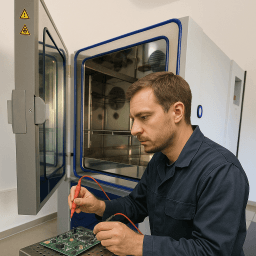
Having an internal, well-equipped laboratory is a massive advantage. It allows for rapid testing and verification of solutions without having to wait for external providers. This shortens time-to-market and reduces costs.Question 3: How is risk managed, and what happens if something goes wrong?
A trusted partner has established procedures for unforeseen situations, such as component delivery delays. Instead of improvising, they have a contingency plan that minimizes the impact on the schedule.Question 4: What does the communication and reporting process look like?
Regular, transparent progress reports give you full control and a sense of security. You know exactly what stage you are at and whether everything is going according to plan. Avoid companies that only communicate when they need payment.Question 5: What is the scalability?
A partner’s ability to scale their services and adapt to the growing requirements of the project as it evolves is a critical factor.Question 6: Who is the formal owner of the final design, code, and data?
A partner must offer clear procedures regarding intellectual property (IP) and data protection, which is not a standard practice for everyone.
Value-Based Choice: What are you really buying when you commission a project?
When commissioning an R&D project, you aren’t just paying for a service. You are paying for something much more valuable.
YOU ARE BUYING EXPERTISE:
Years of working on diverse projects translate into invaluable experience. Seasoned engineers know the most common mistakes and how to avoid them. As a result, your project starts from a high vantage point, and the risk of failure is minimized.YOU ARE BUYING TRANSPARENCY:
A solid R&D partner has nothing to hide. Costs are clear and broken down into stages, protecting you from unexpected surcharges. You receive a legible contract and quotation, not a list of vague line items.YOU ARE BUYING SECURITY:
Your intellectual property and data are critical. A professional partner safeguards them from day one. A non-disclosure agreement (NDA) is standard practice, ensuring your ideas are fully protected.

Case study: The case of Nokia and outsourcing R&D projects
The history of Nokia, the Finnish telecommunications giant, perfectly illustrates how a strategic approach to outsourcing – rather than a blind pursuit of the lowest price – can bring a company benefits such as reduced investment risk and a faster time-to-market.
Nokia, faced with growing market pressure and the need to quickly supplement its offering with products missing from its portfolio (such as the “clamshell” flip phones popular in Asia), decided to collaborate with external partners known as original design manufacturers (ODMs).
Instead of investing in the costly and time-consuming development of internal R&D projects, Nokia purchased ready-made designs from specialized manufacturers, such as BenQ. Although the initial cost of purchasing a finished design from an ODM might have seemed higher than developing it in-house, it allowed Nokia to achieve:
Rapid market entry: Through outsourcing, Nokia was able to launch new models almost instantly, gaining a competitive edge and satisfying urgent market demand.
Risk reduction: Converting fixed costs (investments in factories and R&D departments) into variable costs (fees for a finished design) significantly reduced financial risk. In a volatile market environment, this was crucial for maintaining liquidity and driving further company growth.
Access to specialized expertise: ODMs possessed unique knowledge and experience in specific niches, allowing Nokia to leverage their innovations without the need to build those competencies from scratch.
This case demonstrates that in dynamic sectors like electronics, decisions based on strategic value – rather than unit price minimization – are paramount. Partners who facilitate rapid market entry, mitigate risk, and provide access to rare expertise generate real savings that far outweigh the costs associated with lost profits, delays, or reputational damage.
SUMMARY
Choosing an R&D partner for an electronics project is a strategic decision that shapes the future of your product. Instead of focusing on short-term savings, prioritize quality, experience, and transparency. Remember that a low price often signifies high risk and hidden costs, which can derail the entire project in the long run.
Invest in a partner that offers you security, clarity, and expertise, rather than just “billable hours”. These are the values that will provide you with real savings and market success. Are you ready to invest in quality instead of just price? Contact us for a free consultation and see how Prodel Electronics can minimize the risk of your project.